
100KVA Single Phase Pole Mounted Transformer 34.5KV to 120V/240V
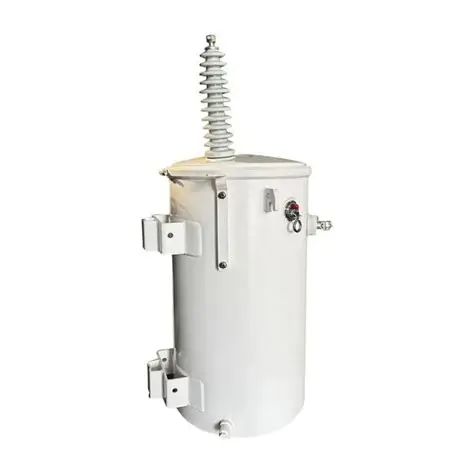
100KVA Single Phase Pole Mounted Transformer 34.5KV to 120V/240V
Main Parameters
Parameter | Specification |
Rated power | 100 kVA, continuous, 60 Hz |
Type | Single-phase, two-winding, oil-immersed pole mounted distribution transformer |
Primary voltage | 34,500 V (34.5 kV class) |
Taps | ±2 × 2.5%, off-load, five positions: 36,225 / 35,362 / 34,500 / 33,637 / 32,775 V |
Secondary voltage | 120/240 V, three-wire, centre-tapped neutral |
Polarity | Additive |
Insulation level | 150 kV BIL, 34.5 kV class |
Impedance | 2.0–2.5%, typically 2.2% at 75 °C |
No-load loss | ≈ 210 W, DOE 2016 level |
Load loss | ≈ 1,050 W at 75 °C, full load |
Full-load efficiency | ≈ 98.7% |
Temperature rise | 55 °C average winding rise standard; 65 °C rise available for higher loading |
Cooling | ONAN, mineral oil, sealed tank |
Insulating fluid | Naphthenic mineral oil, ≈ 115 L; FR3 ester for high fire-point sites on request |
Core | Grain-oriented silicon steel, mitred step-lap joints |
Windings | Copper HV layer winding and copper LV sheet standard; aluminium on request |
Tank | Welded mild steel, hermetically sealed, pressure-relief device, no conservator |
HV bushing | Porcelain, single bushing, tank grounded |
Secondary terminals | Two 120 V legs plus neutral, stud terminals under a removable cover |
Protection | Conventional or CSP: internal HV fuse, MOV arrester, secondary breaker |
Tap changer | Off-load, lockable external handle |
Finish | ANSI 70 light grey over zinc-rich primer |
Sound level | ≤ 45 dB, NEMA test distance |
Mass | ≈ 420 kg complete, oil ≈ 115 L |
Mounting | Pole bracket or platform, lifting lugs, grounded tank lug |
Standards | IEEE C57.12.00, C57.12.20, C57.12.90; DOE 10 CFR 431; IEC 60076 on request |
Tests | Routine: winding resistance, ratio, polarity, no-load loss, load loss and impedance, applied and induced voltage, oil breakdown. Impulse on design |
Loss figures are design values for the standard build. Every unit ships with a routine test report carrying the measured no-load loss, load loss and impedance for that serial number, because those are the numbers a utility auditor will ask for, not the catalogue ones.
Product Description
The 34.5 kV to 120/240 V single phase transformer is built around a two-limb, mitred core. Grain-oriented steel at step-lap joints keeps excitation current low, which matters more than it sounds: a lower inrush spike makes fuse and cutout coordination predictable on a feeder that already carries a dozen other transformers. The HV winding is a copper layer winding wound to 150 kV BIL, and the LV side is a copper sheet with the two 120 V halves brought out separately so the centre tap gives a true neutral.
The tank is welded, hermetically sealed and filled under vacuum. There is no conservator and no oil sight glass to watch, which is deliberate. Sealed units are the reason a pole mounted transformer can sit on a bracket for twenty years with nothing but an occasional visual check; the oil expands into the tank headspace and a pressure-relief device covers the fault case. If your fire code requires a higher flash point, the same tank is available with ester fluid instead of mineral oil.
The primary uses a single bushing with the tank grounded, which is the normal arrangement for a radial 34.5 kV feeder. Two-bushing versions exist for section switching, but they are not the standard build and should be specified up front. On the secondary, two stud terminals and a neutral sit under a bolt-on cover, sized for the 100 kVA current of roughly 417 A at 240 V.
The five tap positions exist because 34.5 kV feeders are rarely at nominal voltage. A long rural feeder running low gets the 33,637 or 32,775 V position, a short feeder near the substation gets 35,362 or 36,225 V, and the regulator settings stay where the utility put them. The handle is external and lockable, so a lineman can change taps without opening the tank.
Two protection packages are offered. The conventional unit is a plain transformer that relies on the upstream cutout and arrester. The CSP version adds an internal HV fuse, an MOV arrester and a secondary breaker inside the tank, which removes three external components from the pole and simplifies inspection. Most co-ops in North America buy CSP; export projects frequently choose conventional and handle protection at the pole.
Core Uses
This unit does one job, and everything else follows from it: it takes 34.5 kV down to the 120/240 V three-wire service that single-phase loads are wired for. In practice that means five recurring uses.
• Final-step voltage conversion. It is the last transformation on a feeder, feeding service entrances directly rather than another transformer downstream.
• Single-phase service supply. Lighting, receptacles, domestic appliances, small motors and control circuits that need a neutral, not a three-phase industrial supply.
• Feeder capacity where three-phase is not justified. A cluster of five or six houses or one farm does not pay for a three-phase bank, and a 100 kVA single-phase pole mounted transformer covers it at a fraction of the cost.
• Isolation and sectionalising. Placed at the end of a spur, the unit lets a utility serve a small load pocket without extending the three-phase main.
• Standby and replacement stock. 100 kVA is a common rating in co-op and municipal inventories, so it doubles as the spare that gets a feeder back on after a failure.
Application Scenarios
The rating suits loads that are single-phase, spread out and moderate. The table maps the situations we quote this transformer for most often, with the load band that keeps it in a healthy 50–80% utilisation range.
Scenario | Typical connected load | Why 100 kVA fits |
Rural electrification and farm service | House, barn, irrigation pump, grain dryer, workshop | 34.5 kV subtransmission is standard in rural co-op territory; one unit serves a whole farmstead with 120/240 V three-wire power |
Residential subdivisions and infill | Five to eight homes at diversified demand | Matched to the usual diversity factor, with the 240 V legs shared across service drops |
Small commercial and light industrial | Shop, workshop, fuel station, small cold store | Handles welders, compressors and lighting without the cost of a three-phase service |
Oil and gas lease sites | Pump jack controls, instrumentation, site lighting, crew quarters | 34.5 kV is the common lease voltage; sealed tank and CSP option suit unattended sites |
Construction and camp power | Site office, tools, temporary lighting, small mixer | Pole-mounted, relocatable and re-usable on the next project |
Remote communities and small microgrids | Village cluster, small solar or diesel hybrid, water pumping | A single-phase backbone with several of these units is often cheaper than a three-phase network |
Where the load is genuinely three-phase — a 30 kW irrigation pivot drive, a mill, a larger cold store — this is the wrong transformer, and no amount of tap adjustment fixes it. Sizing is a matter of diversified demand, not connected nameplate, which is why we ask for the load list before quoting a pole mounted transformer for a subdivision.
Product Features
Most of what distinguishes a good 100 kVA pole mount is invisible after installation. These are the points buyers actually check.
• DOE 2016 loss level. No-load loss around 210 W and load loss around 1,050 W put the unit inside the US efficiency limits and keep the twenty-year loss cost low. On a heavily loaded feeder the difference against a cheap core pays back the price gap in a few years.
• Sealed, maintenance-free tank. No conservator, no oil gauge, no gaskets to re-torque. Oil is processed and filled under vacuum, so moisture stays out from the first day.
• 150 kV BIL insulation at 34.5 kV. Layer-wound HV with graded insulation, corona-free porcelain bushing, impulse-tested design — this is the part that decides whether the unit survives a lightning season.
• Five tap positions. ±2 × 2.5% covers the voltage spread on real feeders instead of assuming nominal.
• Copper windings and step-lap core. Low excitation current, low inrush, quieter operation and better short-circuit withstand than thin aluminium equivalents.
• CSP or conventional, your choice. Internal fuse, arrester and secondary breaker for utilities that want a self-protected unit, or a plain transformer for projects that protect at the pole.
• Pole-ready mechanicals. Lifting lugs, bracket or platform mounting, grounded tank lug and ANSI 70 grey finish that matches utility stock.
• Traceable test data. Routine test report per serial number, plus a nameplate with ratio, impedance, losses and tap schedule, so the unit enters an asset register without guesswork.
Questions Buyers Ask
Question | Answer |
How many homes will a 100 kVA unit carry? | Roughly six to ten, at a diversified demand of 5–8 kW per home. Homes with electric heating, heat pumps or EV chargers sit at the low end, and the utility's own diversity factor overrides any rule of thumb. |
Can it run on a 50 Hz system? | No. This design is 60 Hz at 34.5 kV. A 50 Hz unit needs a different core and turns count; we quote it as a separate 33 kV / 34.5 kV variant rather than derating this one. |
Why is impedance only 2.2%? | Low impedance keeps voltage regulation tight on a long single-phase spur. The trade-off is higher fault current at the service, which is why secondary protection and service grounding have to be coordinated with the utility. |
CSP or conventional? | CSP if the pole should be self-protected and you want fewer external devices to inspect. Conventional if your protection philosophy sits upstream or the unit feeds a switchgear downstream. |
What do you need for a quotation? | Primary voltage and tap schedule, CSP or conventional, mineral oil or ester, mounting type, quantity and destination port. Test reports and a certified nameplate drawing come with the offer. |
Send the load list and the feeder voltage with the enquiry and the specification comes back matched to the project rather than to a generic catalogue page. That is the difference between a transformer that sits at 55% loading for twenty years and one that trips on the first hot afternoon in August.