
China Factory Hot Sales Customized 20kv 400v Three Phase Oil Immersed Transformers
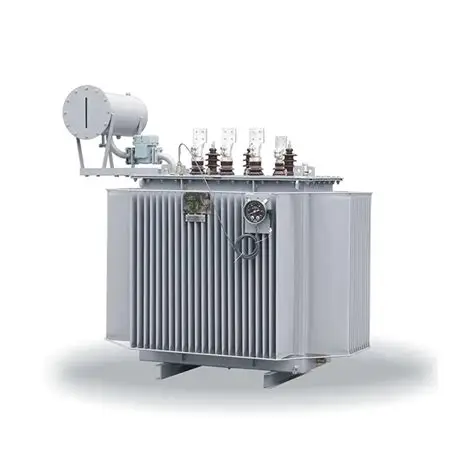
China Factory Hot Sales Customized 20kv 400v Three Phase Oil Immersed Transformers
Main Parameters
Parameter | Specification |
Rated power | 1,600 kVA reference design; 200–2,500 kVA available; ONAF rating on request |
Type | Three-phase, two-winding, oil-immersed distribution transformer |
Frequency | 50 Hz standard; 60 Hz as a separate design |
Primary voltage | 20,000 V nominal, Um 24 kV |
Primary options | 20 kV single ratio, or dual ratio 20/10 kV with a selector link |
Taps | ±2 × 2.5% standard; ±5% in 2.5% steps or a wider range on request |
Secondary voltage | 400 V line-to-line, 230 V line-to-neutral; 415, 440, 480 V on request |
Vector group | Dyn11 standard; Yyn0, Yzn11 or Dd0 on request |
Rated current | ≈ 46.2 A on the HV side, ≈ 2,309 A on the LV side |
Impedance | 6.0% at 75 °C; 5.0–7.0% according to the project's fault level |
No-load loss | ≈ 1,700 W |
Load loss | ≈ 14,500 W at 75 °C, full load |
Full-load efficiency | ≈ 99.0% |
Temperature rise | 65 K average winding, 60 K top oil; 55 K version for high ambient |
Cooling | ONAN standard; ONAF with fans and a control box on request |
Insulating fluid | Mineral oil to IEC 60296, ≈ 900 kg; ester fluid on request |
Core | Grain-oriented silicon steel, three-limb, mitred step-lap joints |
Windings | Copper HV layer winding with graded insulation, copper LV foil; aluminium on request |
Tank | Welded steel, corrugated wall, hermetically sealed; conservator version with Buchholz relay on request |
Insulation level | 125 kV lightning impulse, 50 kV power-frequency withstand at Um 24 kV |
HV termination | Cable box IP54 or outdoor porcelain bushings, 24 kV class |
LV termination | Cable box or busbar chamber rated for the ≈ 2,310 A secondary current |
Tap changer | Off-circuit, five positions, lockable, external handle; on-load tap changer quoted separately |
Instrumentation | Dial thermometer, oil level gauge where a conservator is fitted; winding temperature indicator and CTs for metering on request |
Fittings | Pressure relief device, drain and filter valves, lifting lugs, jacking pads, earthing terminals, rating plate in the buyer's format |
Paint | ISO 12944 C3 indoor, C4 standard outdoor, C5-M for coastal and chemical sites |
Sound level | ≤ 58 dB(A) at 1 m |
Mass | ≈ 3,800 kg complete; oil ≈ 900 kg |
Standards | IEC 60076-1, -2, -3, -5, -10; IEC 60137 bushings; IEC 60296 oil; GB 1094 equivalent |
Tests | Routine: winding resistance, ratio and vector group, no-load loss and current, load loss and impedance, applied and induced voltage, insulation resistance, oil breakdown, tap changer operation. Type: impulse, temperature rise, sound level. Witnessed FAT and third-party inspection on request |
Loss values are design figures. Every unit ships with a routine test report carrying the measured no-load loss, load loss, impedance and ratio for that serial number, and on a customised build the report should also record the vector group, tap range and secondary voltage actually wound.
Product Description
The 20 kV side is the reason this is a project build. Um 24 kV and a 125 kV impulse level call for a graded HV winding with more insulation turns, wider oil ducts, a taller tank and 24 kV bushings with longer creepage. A 1,600 kVA unit at this class weighs around 3.8 tonnes with 900 kg of oil, against roughly 2.2 tonnes for the equivalent 10 kV build — that extra mass is mostly dielectric structure, not copper.
The secondary at 400 V carries about 2,309 A, which is busbar territory. Copper foil winding, a cable box with gland plates or a busbar chamber, and terminals sized for that current rather than a nominal figure. A 6% impedance holds prospective fault current near 38 kA, which is inside the range of ordinary 400 V switchgear and gives protection a chance to coordinate with the upstream feeder.
Now the customisation boundary, which is the part worth arguing about. The ratio, tap range, vector group, secondary voltage, terminations, paint class, protection accessories, instrumentation, nameplate format, packing and test witnesses can all be set by the buyer, and a factory that says otherwise is just not organised for project work. Loss level can also be chosen, but it moves the price: a lower loss design means more core steel and more copper.
What cannot be customised is the relationship between the numbers. Impedance, temperature rise, losses and short-circuit withstand trade against each other. Ask for 4% impedance on a 1,600 kVA 20 kV unit and the fault current goes up while the winding's short-circuit forces also go up, so the winding and clamping have to change with it. Ask for a 55 K rise and the cooling surface or the material content has to grow. A buyer who specifies all four independently usually gets a quotation with a note attached, and the note is the honest part.
Dual-ratio primaries are a genuinely useful customisation on this class: a 20/10 kV winding with a selector link lets one unit serve two network voltages, which matters for plants built in phases or for export projects where the local medium-voltage standard is not settled. It costs an extra winding section and a heavier tank, and it has to be decided at the design stage rather than retrofitted.
On "hot sales", the configurations that actually move volume are unglamorous: 20/0.4 kV, 630–1,250 kVA, Dyn11, sealed corrugated tank, cable box both sides, C4 paint, standard fittings. That is the build that goes into industrial parks, cement plants, mines and water works by the hundred. The exotic versions exist and get built, but they are project units rather than stock, and the price reflects that.
Core Uses
The unit takes 20 kV down to a 400 V three-phase supply. Five uses account for most orders on this platform.
• Industrial parks and plant incoming supply. One 20 kV connection stepped down to 400 V for the whole low-voltage distribution.
• Mining, cement and heavy process. High starting duty and dusty sites, usually with C5-M paint and a cable box on both sides.
• Water and wastewater works. Pump motors, blowers and controls on outdoor or semi-outdoor plinths.
• Utility LV distribution points on 20 kV networks. A transformer at the end of a 20 kV feeder serving a residential or mixed cluster.
• Projects with a phased medium-voltage standard. Dual 20/10 kV primary serving two network voltages from one unit.
Application Scenarios
This platform suits loads from a few hundred kVA to 2.5 MVA where the supply is 20 kV and the distribution is 400 V. The table maps the situations that generate most of our customised orders.
Scenario | Typical load | Why this unit fits |
Industrial parks and factories | Motor loads, process lines, plant lighting | 20 kV is the incoming voltage in many networks; 400 V matches local motors and panels |
Mining and heavy industry | Crushers, conveyors, heavy motors | Sealed tank, C5-M paint and 55 K option for dusty, hot, coastal sites |
Water and wastewater | Pumps, blowers, controls | Outdoor plinth installation with IP54 cable boxes and no serviceable parts |
Utility LV distribution | Residential cluster, shops, street lighting | Standard rating held as spares, with documentation matching the asset register |
Phased plant construction | First phase on 10 kV, later phases on 20 kV | Dual-ratio primary with a selector link avoids replacing the transformer mid-project |
Overseas EPC packages | Site distribution, repeated across a project | Nameplate, test report and packing list issued in the format the project requires |
Two limits are worth stating. Where the incoming supply is 35 kV, this is not the right unit whatever the taps say — the insulation class and the ratio are both wrong, and no amount of customisation closes that gap. And where the site is genuinely single-phase, a three-phase transformer is an expensive way to serve it.
Product Features
What a customised build has to deliver is a unit that matches the approved drawing, with the compromises documented rather than discovered.
• 20 kV class insulation, built for it. 125 kV impulse level, graded HV winding, wider oil ducts and 24 kV bushings with real creepage.
• Options quoted as line items. Dual ratio, wider taps, ONAF, conservator with Buchholz, CTs, WTI, paint class and nameplate format each priced separately.
• Measured losses per unit. Around 1,700 W no-load and 14,500 W load loss, on a serial-numbered report alongside the wound ratio and vector group.
• Sealed corrugated tank. Vacuum filled, no breather to service; conservator version available where utility practice expects one.
• Copper windings, declared. Material named on the nameplate and the offer, so it can be verified at inspection rather than assumed.
• Terminations sized for 2,309 A. Cable box with gland plates or busbar chamber, quoted against the real secondary current.
• Impedance agreed with the fault level. 5.0–7.0% selected per project so breakers and protection settings line up at the first review.
• Drawings approved before production. Outline, connection and foundation drawings signed off, then a per-unit test report and packing list.
Questions Buyers Ask
Question | Answer |
What can actually be customised? | Ratio, taps, vector group, secondary voltage, terminations, cooling, protection accessories, instrumentation, paint class, nameplate format and packing. Loss level too, within what the design can reach. |
What cannot? | The trade-off between impedance, losses, temperature rise and short-circuit withstand. Specify all four independently and the quotation will come back with a note — the note is where the engineering is. |
Is a dual 20/10 kV primary worth it? | If the plant is built in phases or the local medium-voltage standard is still being settled, yes. It adds a winding section and tank height, and it has to be decided at design stage. |
Why is 6% impedance common at this rating? | It holds secondary fault current near 38 kA, which ordinary 400 V switchgear can break, and it limits short-circuit forces on a 20 kV winding that sees more stress than a 10 kV one. |
Can the same unit be 400 V and 440 V? | Not on one winding. The secondary voltage is fixed at winding, so it has to be chosen at order; taps correct supply variation, not the service voltage. |
What is needed for the offer? | Rating, primary voltage and tap range, secondary voltage, vector group, impedance or fault level, cooling, terminations, paint class, accessories, ambient and altitude, quantity and destination port. |
Send the specification with the single-line diagram and the fault level, and ask which of your requirements the design cannot meet as written. A factory that answers that question straight is the one that will build the unit you drew — and on a 20 kV customised order, the drawing is the contract.