
IEC Standard Factory Price 10kv Three Phase Oil Immersed Transformers
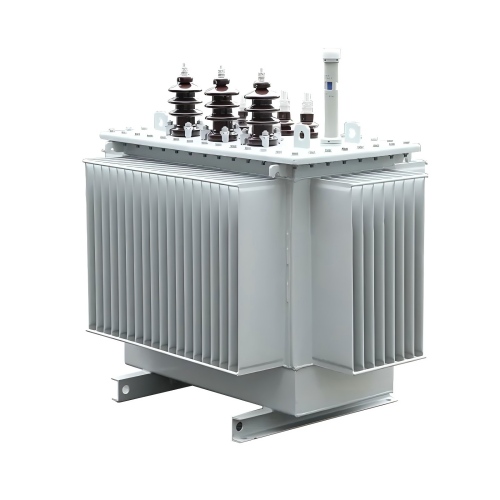
IEC Standard Factory Price 10kv Three Phase Oil Immersed Transformers
Main Parameters
Parameter | Specification |
Rated power | 800 kVA reference design; 100–2,500 kVA available |
Type | Three-phase, two-winding, oil-immersed distribution transformer |
Frequency | 50 Hz standard; 60 Hz as a separate design |
Primary voltage | 10,000 V nominal, Um 12 kV |
Taps | ±2 × 2.5%, off-circuit, five positions: 10,500 / 10,250 / 10,000 / 9,750 / 9,500 V |
Secondary voltage | 400 V line-to-line, 230 V line-to-neutral (415, 440, 480 V on request) |
Vector group | Dyn11 standard; Yyn0 or Dd0 on request |
Rated current | ≈ 46.2 A on the HV side, ≈ 1,155 A on the LV side |
Impedance | 4.5% at 75 °C; 4.0–6.0% according to the project's fault level |
No-load loss | ≈ 950 W |
Load loss | ≈ 7,800 W at 75 °C, full load |
Full-load efficiency | ≈ 98.9% |
Temperature rise | 65 K average winding, 60 K top oil; 55 K version for high ambient |
Cooling | ONAN; ONAF available on larger ratings |
Insulating fluid | Mineral oil to IEC 60296, ≈ 520 kg; ester fluid on request |
Core | Grain-oriented silicon steel, three-limb, mitred step-lap joints |
Windings | Copper HV layer winding, copper LV foil; aluminium on request |
Tank | Welded steel, corrugated wall, hermetically sealed; conservator version available |
Insulation level | 75 kV lightning impulse, 28 kV power-frequency withstand at Um 12 kV |
HV termination | Cable box or porcelain bushings, 12 kV class |
LV termination | Cable box or busbar chamber rated for the ≈ 1,155 A secondary current |
Tap changer | Off-circuit, five positions, lockable, external handle |
Fittings | Pressure relief device, thermometer pocket, drain and filter valves, lifting lugs, jacking pads, earthing terminals |
Sound level | ≤ 52 dB(A) at 1 m |
Mass | ≈ 2,200 kg complete; oil ≈ 520 kg |
Standards | IEC 60076-1, -2, -3, -5, -10; IEC 60137 bushings; IEC 60296 oil; GB 1094 equivalent |
Tests | Routine: winding resistance, ratio and vector group, no-load loss and current, load loss and impedance, applied and induced voltage, insulation resistance, oil breakdown, tap changer operation. Type: impulse, temperature rise, sound level |
Loss values are design figures and are the single biggest lever on factory price. The routine test report that ships with each unit carries the measured no-load loss, load loss, impedance and ratio for that serial number — and those measured numbers are what the loss calculation below should use.
Product Description
The electrical design is conventional: a three-limb grain-oriented core with mitred step-lap joints, a copper layer winding on the HV side with graded insulation at a 75 kV impulse level, and a foil LV winding that carries about 1,155 A without the hot-spot spread that thin aluminium develops at this current. A 4.5% impedance holds the prospective secondary fault current near 26 kA, which is within the breaking capacity of ordinary 400 V switchgear, and five off-circuit taps cover the 9,500–10,500 V band that real 10 kV feeders sit in.
The tank is corrugated and sealed under vacuum. Expansion goes into the tank wall, so there is no conservator, no breather and no oil gauge — which removes the small maintenance tasks that get skipped on a busy site. Where a utility's practice expects a conservator, that version is available, and it changes the height and shipping volume, so it is worth deciding at the offer stage.
Now the price part, honestly. A factory price on this unit is made of copper weight, core grade and loss level, oil, tank steel and paint, labour, testing and packing. Of those, the loss level is the one a buyer can trade against purchase price, and it is also the one that is hardest to see in a quotation that only shows a total. An offer with 200 W more no-load loss is cheaper to build and more expensive to own, every hour of every year.
Take the arithmetic. A transformer that stays energised draws its no-load loss continuously: 200 W extra is about 1,750 kWh a year. At an assumed 0.10 USD per kWh that is roughly 175 USD a year, or 3,500 USD over twenty years before any discounting — usually more than the price difference between a good core and a cheap one. Load loss behaves differently: it scales with the square of the load, so it matters most on a unit that runs near rating, and hardly at all on one that idles at 30%.
That is why comparing factory prices without a loss figure is not a comparison at all. Ask for the measured no-load and load loss, then multiply by your own tariff and hours. Freight is the other variable worth checking: a heavier core and copper build adds weight, and on a long sea route that can eat part of the saving — but rarely all of it.
Core Uses
The unit takes 10 kV down to a 400 V three-phase supply for a plant or a building section. Five uses account for most orders on this platform.
• Plant incoming supply. One 10 kV connection stepped down to 400 V for the whole low-voltage distribution.
• Motor and process load supply. Pumps, compressors, fans, conveyors and machine lines fed at 400 V.
• Commercial and mixed-use buildings. HVAC, lifts, lighting and tenant distribution from a single transformer.
• Utility LV distribution points. A transformer at the end of a 10 kV feeder serving a residential or mixed cluster.
• Replacement and capacity upgrades. Ageing units swapped for a low-loss build on the same foundation and cable entries.
Application Scenarios
This platform suits loads from a few hundred kVA to a couple of MVA where the supply is 10 kV and the distribution is 400 V or another 0.4–0.48 kV standard. The table maps the situations that generate most enquiries.
Scenario | Typical load | Why this unit fits |
Industrial plants and factories | Motor loads, process lines, plant lighting | 10 kV is the common incoming voltage; 400 V matches local motors and panels |
Commercial and residential buildings | HVAC, lifts, tenant and dwelling distribution | Compact sealed unit for a basement or plinth; Dyn11 gives 230 V for single-phase circuits |
Water treatment and pumping | Pump motors, blowers, controls | Sealed tank and 65 K rise suit unattended stations in hot climates |
Utility LV distribution | Residential cluster, shops, street lighting | Standard rating held as spares, with consistent test documentation |
EPC and export projects | Site distribution, often repeated across a project | Per-unit test reports, witnessed FAT and packing that survives sea freight |
Energy cost reduction programmes | Ageing transformers with high no-load loss | Low-loss core pays back through the loss bill rather than through output |
Two limits are worth stating. Where the incoming supply is 20 kV or 35 kV, this is not the right unit whatever the taps say — the insulation class and the ratio are both wrong. And where the load is genuinely single-phase, a three-phase transformer is an expensive way to serve it; a single-phase pole mount usually costs less and takes less space.
Product Features
At this rating, what separates a good factory build from a cheap one is measurable. These are the points to check.
• IEC test regime, per unit. Routine tests to IEC 60076-1 with a serial-numbered report, plus type tests for impulse, temperature rise and sound level on the design.
• Loss level stated in the offer. Around 950 W no-load and 7,800 W load loss, so a buyer can calculate lifetime cost instead of comparing totals.
• Copper windings, declared. Winding material named on the nameplate and the offer, so it can be verified on arrival.
• Sealed corrugated tank. Vacuum filled, no conservator or breather to service; conservator version available on request.
• 10 kV class insulation. 75 kV impulse level, graded HV winding, 28 kV withstand and bushing creepage sized for outdoor service.
• Terminations matched to current. 1,155 A secondary handled through a cable box with gland plates or a busbar chamber, not a nominal terminal block.
• Impedance agreed with the fault level. 4.0–6.0% selected per project so breakers and protection settings line up at the first review.
• Factory acceptance testing. Witnessed FAT available, with third-party inspection where the project calls for it.
Questions Buyers Ask
Question | Answer |
What does factory price include? | The transformer as specified, routine testing, standard paint, nameplate, test report and export packing. Freight, insurance, duties and site services are usually separate — ask for the incoterm. |
Why do two offers on the same datasheet differ by a third? | Copper versus aluminium, core grade, loss level, tank and paint quality, protection package, and whether the test report is per unit. A quote with no loss figures cannot be compared at all. |
How do I use the loss figures? | Multiply no-load loss by 8,760 hours and load loss by expected load factor squared, then by your tariff. That annual figure, times the service life, is the real price difference. |
Is aluminium cheaper and good enough? | It is cheaper and it is a legitimate choice at light loading. At 1,155 A the hot-spot margin gets thin, so the loss and temperature figures matter more than the material label. |
Can the secondary be 415 V or 440 V? | Yes, on the same core and tank. The secondary voltage is fixed at winding, so it has to be stated at order rather than adjusted later. |
What is needed for a quotation? | Rating, primary and secondary voltage, vector group, impedance or fault level, termination and cooling, ambient and altitude, quantity, destination port and the incoterm. |
Put the loss figures and the incoterm in the same table as the price. Once those three numbers sit side by side, the cheapest offer and the best offer stop being the same document — and the choice becomes an engineering decision rather than a purchasing one.