
Manufacturer Competitive Price Single Phase Pole Mounted Transformer 13.8Kv to120V/480V
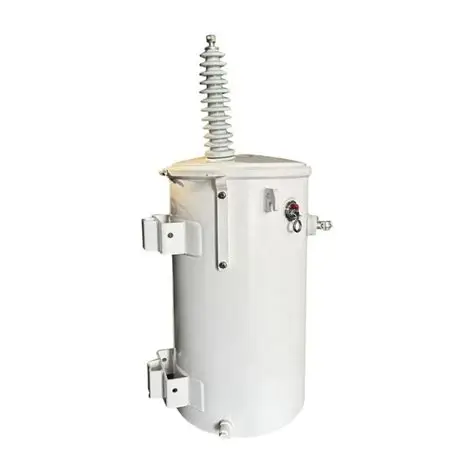
Manufacturer Competitive Price Single Phase Pole Mounted Transformer 13.8Kv to120V/480V
Main Parameters
Parameter | Specification |
Rated power | 167 kVA at 480 V reference design; 25–167 kVA available |
Type | Single-phase, two-winding, oil-immersed pole-mounted distribution transformer |
Frequency | 60 Hz standard; 50 Hz as a separate design |
Primary voltage | 13,800 V nominal, 13.8 kV class |
Taps | ±2 × 2.5%, off-circuit, five positions: 14,490 / 14,145 / 13,800 / 13,455 / 13,110 V |
Secondary voltage | 480 V with a 120 V tap on one quarter of the winding |
Polarity | Additive |
Rated current | ≈ 12.1 A on the HV side; ≈ 348 A at 480 V |
Capacity at 120 V | ≈ 42 kVA, limited by the rated current in the tapped section |
Impedance | 2.5% at 75 °C; 2.0–3.0% according to the fault level on the spur |
No-load loss | ≈ 330 W |
Load loss | ≈ 1,900 W at 85 °C, full load |
Full-load efficiency | ≈ 98.7% |
Temperature rise | 65 °C average winding rise; 55 °C rise version for hot sites |
Cooling | ONAN |
Insulating fluid | Mineral oil to ASTM D3487 / IEC 60296, ≈ 175 kg; ester fluid on request |
Core | Grain-oriented silicon steel, two-limb, mitred step-lap joints |
Windings | Copper HV layer winding with graded insulation, copper LV winding with a tapped section; aluminium on request |
Tank | Welded steel, corrugated wall, hermetically sealed, pole bracket, lifting lugs, jacking provision for a plinth |
Insulation level | 95 kV lightning impulse, 34 kV power-frequency withstand at 13.8 kV class |
HV bushing | Porcelain, 15 kV class, single bushing with the tank grounded; two-bushing version on request |
LV terminals | 480 V pair plus a 120 V pair, separately marked, rated for the ≈ 348 A secondary current |
Protection | Conventional with upstream cutout and arrester, or CSP with internal HV fuse, arrester and secondary breaker |
Fittings | Pressure relief device, drain plug, fill plug, lifting lugs, earthing lug, pole bracket, arrester mounting provision |
Sound level | ≤ 50 dB(A) at 1 m, NEMA test distance |
Mass | ≈ 640 kg complete; oil ≈ 175 kg |
Standards | IEEE C57.12.00, C57.12.20, C57.12.90; IEC 60076-1 reference for export projects |
Tests | Routine: winding resistance, ratio and polarity on both connections, no-load loss and current, load loss and impedance, applied and induced voltage, oil breakdown. Type: impulse, temperature rise, sound level |
Loss values are design figures. Each unit ships with a routine test report carrying the measured no-load loss, load loss, impedance and ratio for that serial number, tested at both 480 V and the tapped 120 V connection.
Product Description
The primary is a 13.8 kV class winding at a 95 kV impulse level with 34 kV applied potential — the standard 15 kV class structure, which at this rating needs a graded winding, proper oil ducts and a 15 kV bushing with enough creepage for a rural pole. Primary current is about 12 A, so the HV conductor is small and the insulation, not the copper, sets the winding size.
The secondary is where this ratio earns its keep. At 480 V the unit carries about 348 A, which is roughly half the current a 240 V unit of the same kVA would carry. That means smaller service conductors, smaller lugs, less I²R loss in the service run — and on a long rural service, the cable saving can be a real fraction of the installed cost. The 120 V tap is taken across one quarter of the winding and delivers about 42 kVA at 167 kVA nameplate, enough for a control panel, lighting, instrumentation and a small receptacle circuit, not enough for a second heavy service.
Impedance is 2.5%, holding prospective fault current near 14 kA at 480 V. That is above the rating of some small service panels, so the 480 V equipment should be checked against it rather than assumed — a 10 kA panel on a 14 kA source is a coordination problem that shows up as a burnt breaker, not as a transformer fault.
Mechanically, 640 kg is not a one-person lift. The unit goes on a pole with a bracket and a line truck, or onto a plinth using the jacking provision. Below about 400 kg, pole mounting is routine; above 500 kg, many utilities prefer a pad or a plinth, and it is worth asking the utility which they will accept before the order.
Now the cost comparison, since that is what this title is about. Against a three-phase 480 V unit of similar kVA, the single-phase unit is cheaper to buy, cheaper on pole hardware (one bracket, one bushing) and simpler to protect — but it cannot serve a three-phase motor, and on many farms the pump is three-phase. Against two smaller single-phase units, it saves a pole and a set of hardware but concentrates the load, so a single failure takes the whole site down rather than half of it.
A competitive price on this build is therefore not the lowest number in the inbox. It is the number that includes the right insulation class, a winding that is actually copper, measured losses, a terminated 120 V pair and a test report that names both connections. Those four items are what a lower quote usually trims, and at 167 kVA the trimming is worth more than the discount.
Core Uses
The unit steps 13.8 kV down to a 480 V single-phase supply with a 120 V auxiliary pair. Five uses account for most orders on this ratio.
• Large irrigation pump panels. 480 V single-phase pump motors, with 120 V for controls and valves.
• Grain drying and farm process. 480 V fans, conveyors and dryers, 120 V for sensors and lighting.
• Oil and gas lease sites. 480 V pump jack or compressor, 120 V instrumentation on the same pole.
• Small industrial sites on 13.8 kV spurs. Welding, compressed air and process loads at 480 V.
• Utility replacement stock. The spare that restores a rural feeder after a storm.
Application Scenarios
This unit belongs where the feeder is 13.8 kV, the working load is 480 V single-phase, and a small 120 V auxiliary circuit is needed on the same pole. The table maps the situations that generate most enquiries.
Scenario | Typical load | Why this unit fits |
Irrigation blocks | 480 V pump motors up to about 30 kW, controls | One pole serves the pump and the panel; 480 V keeps service current and cable size down |
Grain drying sites | Fans, conveyors, dryers | 480 V duty load with 120 V for sensors; taps correct line voltage in harvest season |
Oil and gas lease sites | Pump jack, compressor, lighting | CSP option and sealed tank suit unattended poles |
Small industrial sites | Welder, compressor, machine load | 480 V single-phase where a three-phase service is not justified |
Replacement of a failed unit | Same service, modern loss level | Standard rating and footprint, with documentation for the asset register |
Utility spares | Storm replacement stock | Consistent nameplate and test data across the fleet |
Three limits are worth stating plainly. A three-phase pump cannot be served by this unit, and on many farms the irrigation motor is exactly that — check the motor nameplate before ordering, not the panel label. The 120 V tap is an auxiliary supply at about 42 kVA, not a second service. And at 640 kg, pole mounting depends on what the utility will accept; a plinth may be the cheaper answer once the bracket, the pole and the lift are priced in.
Product Features
At the top of the pole-mount range, the features that matter are the ones that set the total installed cost and the service life.
• 480 V main with a 120 V tap. 348 A at 480 V, about 42 kVA at 120 V, both tested and both marked at the terminals.
• 95 kV BIL for the 15 kV class. Graded HV winding, 34 kV applied potential and bushing creepage sized for a rural pole.
• Measured losses per unit. Around 330 W no-load and 1,900 W load loss, on a serial-numbered report.
• Copper windings both sides. Lower hot-spot temperature and better short-circuit withstand than an aluminium build.
• Sealed corrugated tank. Vacuum filled, no conservator or breather, nothing to service between inspections.
• Pole bracket or plinth jacking. Both mounting provisions built in, so the site decision can be made late without re-ordering.
• CSP or conventional protection. Internal fuse, arrester and secondary breaker for a self-protected pole, or a plain unit protected at the cutout.
• Five tap positions. 13,110–14,490 V covers the spread on a long 13.8 kV spur.
Questions Buyers Ask
Question | Answer |
How much can the 120 V pair carry? | About 42 kVA at 167 kVA nameplate, because the tap uses a quarter of the winding at full rated current. It is for controls and lighting, not a second service. |
Why specify 480 V instead of 240 V? | Half the service current for the same kVA: 348 A against about 696 A. Smaller conductors, smaller lugs and less loss in a long rural service run. |
Can it feed a three-phase irrigation pump? | No. Many farm pumps are three-phase, and the motor nameplate is what matters. If it says three-phase, this is the wrong product whatever the kVA. |
Is 640 kg acceptable on a pole? | It depends on the utility. Above about 500 kg many prefer a plinth, and the unit has jacking provision for that. Ask before ordering rather than after the bracket is up. |
What makes a price competitive rather than just low? | The 95 kV insulation built for the class, copper windings, measured losses, the 120 V pair brought out to terminals, and a test report covering both connections. |
What is needed for the offer? | Rating, primary voltage and taps, 480 V with 120 V tap confirmation, frequency, CSP or conventional, pole or plinth, quantity, altitude and ambient, destination port. |
Send the motor nameplate, the service length and the utility's mounting preference with the enquiry. Those three items decide whether this unit is right at all, and they decide the real installed cost far more than the transformer invoice does.