
Manufacturer Competitive Price y Single Phase Pole Mounted Transformer 34.5Kv to 240V/480V
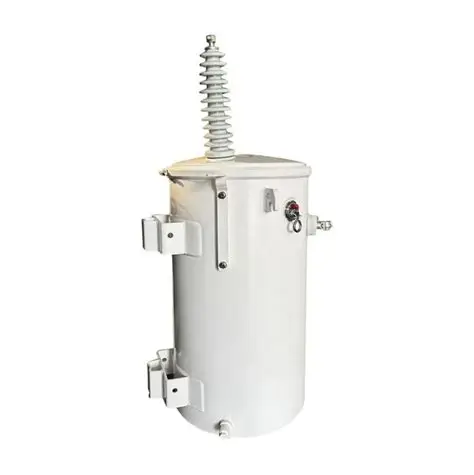
Manufacturer Competitive Price y Single Phase Pole Mounted Transformer 34.5Kv to 240V/480V
Main Parameters
Parameter | Specification |
Rated power | 167 kVA reference design; 25–250 kVA available |
Type | Single-phase, two-winding, oil-immersed pole-mounted distribution transformer |
Frequency | 60 Hz standard; 50 Hz as a separate design |
Primary voltage | 34,500 V nominal, 34.5 kV class |
Taps | ±2 × 2.5%, off-circuit, five positions: 36,225 / 35,362 / 34,500 / 33,637 / 32,775 V |
Secondary voltage | 240 V or 480 V, two-wire, fixed at design; selected at order |
Polarity | Additive |
Rated current | ≈ 4.8 A on the HV side; ≈ 696 A at 240 V, ≈ 348 A at 480 V |
Impedance | 2.5% at 75 °C; 2.0–2.5% according to the fault level on the spur |
No-load loss | ≈ 300 W, DOE 2016 level |
Load loss | ≈ 1,700 W at 85 °C, full load |
Full-load efficiency | ≈ 98.8% |
Temperature rise | 65 °C average winding rise; 55 °C rise version for hot sites |
Cooling | ONAN |
Insulating fluid | Mineral oil to ASTM D3487 / IEC 60296, ≈ 140 kg; ester fluid on request |
Core | Grain-oriented silicon steel, two-limb, mitred step-lap joints |
Windings | Copper HV layer winding with graded insulation, copper LV winding; aluminium on request |
Tank | Welded steel, corrugated wall, hermetically sealed, pole bracket and lifting lugs |
Insulation level | 150 kV BIL, 34.5 kV class; 60 kV applied potential |
HV bushing | Porcelain, single bushing with the tank grounded; two-bushing version on request |
LV terminals | Two stud terminals under a bolt-on cover, sized for the secondary current of the build ordered |
Protection | Conventional with upstream cutout and arrester, or CSP with internal HV fuse, arrester and secondary breaker |
Fittings | Pressure relief device, drain plug, fill plug, lifting lugs, earthing lug, pole bracket, arrester mounting provision |
Sound level | ≤ 48 dB(A) at 1 m, NEMA test distance |
Mass | ≈ 560 kg complete; oil ≈ 140 kg |
Standards | IEEE C57.12.00, C57.12.20, C57.12.90; DOE 10 CFR 431; IEC 60076-1 reference for export projects |
Tests | Routine: winding resistance, ratio and polarity, no-load loss and current, load loss and impedance, applied and induced voltage, oil breakdown. Type: impulse, temperature rise, sound level |
Loss values are design figures and the first place a low price gets built in. The routine test report that goes out with each unit carries the measured no-load loss, load loss, impedance and ratio for that serial number — on this voltage class, insist on the serial number matching the nameplate.
Product Description
The 34.5 kV primary is the part that separates this unit from cheaper single-phase pole mounts. A 150 kV impulse level and a 60 kV applied potential are what the class requires, and in practice that means a graded HV layer winding, generous oil duct spacing, porcelain with adequate creepage and lead routing that keeps the field away from the tank wall. A design adapted from a 15 kV platform will pass a routine test and still fail on the first switching surge, so the insulation has to be built for the class rather than stretched to it.
The secondary is chosen by the load, and the two builds are genuinely different. The 240 V version carries about 696 A at 167 kVA and suits domestic and light commercial service, welding equipment and small pumps. The 480 V version carries about 348 A and suits irrigation pumps, oilfield equipment, grain dryers and larger single-phase motors where 480 V is the site standard. Same core and tank, different secondary turns, so the voltage has to be fixed at order and cannot be changed on site.
Impedance is 2.5%, which at 480 V holds the prospective secondary fault current near 14 kA and at 240 V near 28 kA — the 240 V build carries more fault current simply because its rated current is twice as high. Both are workable, but the service equipment and the breaker ratings have to be chosen against the build actually ordered, not against a generic figure.
The core is a two-limb grain-oriented build with mitred step-lap joints and a no-load loss near 300 W. On a pole that stays energised all year, every 100 W of no-load loss is roughly 876 kWh annually at 60 Hz, and on a co-op with a few hundred of these units that is a line in the loss report rather than a footnote.
Mechanically, the tank is corrugated, sealed and vacuum filled, with expansion absorbed by the wall. No conservator, no breather, no oil gauge, and nothing to top up between inspections. Copper windings on both sides carry the secondary current without the hot-spot spread of thin aluminium, and the low-side terminals are sized for the build ordered — 696 A through a terminal block rated at 400 A is a hot joint in the first summer.
Where a competitive price comes from, honestly: copper instead of aluminium, grain-oriented core instead of scrap-grade steel, measured losses instead of catalogue losses, a sealed tank with proper paint, and a per-unit test report. A 34.5 kV quote that is thirty percent below the field usually moved on two of those, and the buyer finds out at the first lightning season rather than at the inspection.
Core Uses
The unit steps 34.5 kV down to a two-wire 240 V or 480 V single-phase supply. Five uses account for most orders on this ratio.
• Rural co-op distribution. Farmsteads and scattered homes on 34.5 kV lines, where a three-phase extension is not justified.
• Irrigation and stock water pumping. 480 V single-phase pump motors and controls, common where 480 V is the site standard.
• Oil and gas lease sites. Pump jack controls, instrumentation, lighting and crew quarters on a 34.5 kV lease feeder.
• Small commercial and workshop loads. A shop, a welder, a compressor or a dryer on a two-wire service.
• Construction and replacement stock. Temporary site power, and the spare that gets a rural feeder back on after a storm.
Application Scenarios
This unit belongs where the feeder is 34.5 kV and the load is single-phase, spread out and moderate. The table sets out the situations that generate most enquiries.
Scenario | Typical load | Why this unit fits |
Rural co-op feeders at 34.5 kV | Farmsteads, scattered homes, small pumps | Serves a load pocket without extending a three-phase main; 150 kV class matches the feeder |
Irrigation pumping | 480 V single-phase pump motors, 5–30 kW | 480 V build matches the pump stock; taps correct line voltage on long spurs |
Oil and gas lease sites | Pump jack controls, instrumentation, lighting, quarters | CSP option and sealed tank suit unattended sites; 480 V matches lease equipment |
Grain drying and farm process | Dryers, fans, conveyors on 480 V | 480 V single-phase with enough capacity for seasonal peaks |
Small commercial premises | Shop, welder, compressor, lighting | 240 V build covers standard service panels and meters |
Storm and replacement programmes | Utility spares, emergency replacement | Standard rating, 560 kg, set by one line truck, with per-unit test documentation |
Two limits are worth stating. This transformer cannot supply a three-phase load at either voltage, and it should not carry a large motor starting direct-on-line — at 696 A rated on the 240 V build, starting current will dip the whole spur. Size on diversified demand, and let the starting method, not the kVA, decide the rest.
Product Features
On a 34.5 kV pole mount, most of the value is in insulation, current path and documentation. These are the points buyers check.
• 150 kV BIL built for the class. Graded HV winding, adequate oil ducts and porcelain creepage, impulse-tested design rather than a stretched 15 kV platform.
• 240 V or 480 V, fixed at order. Two-wire secondary, 696 A or 348 A at 167 kVA, with terminals sized for the build actually ordered.
• Measured losses. Around 300 W no-load and 1,700 W load loss, DOE 2016 level, with per-unit figures on the test report.
• Sealed corrugated tank. Vacuum filled, no conservator or breather, and nothing to service between inspections.
• Copper windings both sides. Lower hot-spot temperature and better short-circuit withstand than an aluminium build.
• CSP or conventional. Internal fuse, arrester and secondary breaker for a self-protected pole, or a plain unit protected at the cutout.
• Five tap positions. 32,775–36,225 V covers the spread on a long 34.5 kV spur.
• Traceable documentation. Nameplate with ratio, impedance and losses, outline drawing with bracket dimensions, and a test report tied to the serial number.
Questions Buyers Ask
Question | Answer |
Can the same unit be 240 V or 480 V? | No. The secondary turns are fixed at winding, so the build is chosen at order. Primary taps correct supply voltage; they do not change the secondary rating. |
Why is fault current higher on the 240 V build? | Because rated current is twice as high at half the voltage. At 2.5% impedance that puts prospective fault current near 28 kA at 240 V and 14 kA at 480 V. |
What drives a low price on this class? | Winding material, core grade, loss level, tank and paint quality, protection package, and whether the test report is per unit. On 34.5 kV, cutting insulation is the option that fails in service. |
How many homes will 167 kVA serve? | Ten to fifteen at a diversified demand of 5–8 kW per home. Heating, heat pumps and EV charging push it toward the lower end. |
CSP or conventional? | CSP if the pole should be self-protected with fewer external devices to inspect; conventional if protection sits upstream or the service has its own main breaker. |
What is needed for the offer? | Rating, 240 V or 480 V secondary, tap range, CSP or conventional, quantity, altitude and ambient, and the destination port. Drawings and test report format come with the price. |
Ask for the measured losses and the serial-numbered test report before comparing prices, and check that the BIL on the nameplate is 150 kV. Those three items tell you what the unit costs to run and whether it will survive the feeder it is going onto — which is the only definition of a competitive price that holds for twenty years.