
Manufacturer Price IEC ANSI Standard Single Phase Pole Mounted Transformer 10Kv to120V/240V
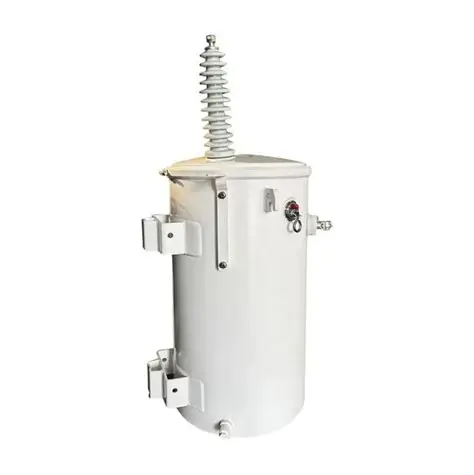
Manufacturer Price IEC ANSI Standard Single Phase Pole Mounted Transformer 10Kv to120V/240V
Main Parameters
Parameter | Specification |
Rated power | 50 kVA reference design; 25–167 kVA available |
Type | Single-phase, two-winding, oil-immersed pole-mounted distribution transformer |
Frequency | 50 Hz or 60 Hz, fixed at design |
Primary voltage | 10,000 V nominal, Um 12 kV (IEC voltage class) |
Taps | ±2 × 2.5%, off-circuit, five positions: 10,500 / 10,250 / 10,000 / 9,750 / 9,500 V |
Secondary voltage | 120/240 V, three-wire, centre-tapped neutral (ANSI service arrangement) |
Polarity | Additive |
Rated current | ≈ 5.0 A on the HV side; ≈ 208 A at 240 V, ≈ 104 A per 120 V leg |
Impedance | 2.5% at 75 °C; 2.0–3.0% according to the fault level on the spur |
No-load loss | ≈ 120 W |
Load loss | ≈ 600 W at 85 °C, full load |
Full-load efficiency | ≈ 98.6% |
Temperature rise | 65 °C average winding rise; 55 °C rise version for high ambient |
Cooling | ONAN |
Insulating fluid | Mineral oil to IEC 60296 / ASTM D3487, ≈ 70 kg; ester fluid on request |
Core | Grain-oriented silicon steel, two-limb, mitred step-lap joints |
Windings | Copper HV layer winding with graded insulation, copper LV winding; aluminium on request |
Tank | Welded steel, corrugated wall, hermetically sealed, pole bracket and lifting lugs |
Insulation level | 75 kV lightning impulse, 28 kV applied potential at Um 12 kV |
HV bushing | Porcelain, single bushing with the tank grounded; two-bushing version on request |
LV terminals | Two 120 V legs plus neutral, stud terminals under a bolt-on cover, rated for the ≈ 208 A secondary current |
Protection | Conventional with upstream cutout and arrester, or CSP with internal HV fuse, arrester and secondary breaker |
Fittings | Pressure relief device, drain plug, fill plug, lifting lugs, earthing lug, pole bracket, arrester mounting provision |
Nameplate | ANSI format with kVA, ratio, polarity, impedance, tap positions and date of manufacture; IEC-format plate available for export registration |
Sound level | ≤ 43 dB(A) at 1 m, NEMA test distance |
Mass | ≈ 290 kg complete; oil ≈ 70 kg |
Standards | IEC 60076-1, -2, -3, -5 for insulation and testing; IEEE C57.12.00, C57.12.20, C57.12.90 for pole-mount construction, protection and nameplate practice |
Tests | Routine: winding resistance, ratio and polarity, no-load loss and current, load loss and impedance, applied and induced voltage, oil breakdown. Type: impulse, temperature rise, sound level |
Loss values are design figures. Each unit ships with a routine test report carrying the measured no-load loss, load loss, impedance and ratio for that serial number, and on a dual-standard build the report should name the test standard used for each item.
Product Description
The coil is unremarkable, which is the point. Ten kilovolts draws about 5 A at 50 kVA, so the HV side is a copper layer winding with graded insulation, a 75 kV impulse level for the 12 kV class, and a single porcelain bushing with the tank grounded. The secondary is a centre-tapped winding: 208 A at 240 V across the outer terminals, about 104 A per leg at 120 V, with the neutral brought out for the standard three-wire service. A 2.5% impedance holds prospective fault current near 8.3 kA, comfortably inside ordinary service equipment ratings.
Where the standards split is this. IEC 60076 governs the electrical part: the impulse level, the applied potential test, the loss measurement method and the temperature rise procedure. IEEE C57.12.20 governs the product as a utility asset: the single-bushing pole arrangement, the additive polarity convention, the CSP option with internal fuse and secondary breaker, the nameplate fields, and the terminal layout that a lineman expects to find under the cover. A dual-standard unit is an IEC transformer in ANSI clothing — not a compromise, but also not a unit where both documents cover every item.
On a 50 kVA order that matters commercially, because the compliance items are a large fraction of a small total. Two nameplate formats, two test-report templates, CSP hardware if specified, an inspector who may check under both regimes, and the documentation that has to exist before the unit can be registered on a utility's asset list. On a 2,500 kVA unit those costs disappear into the material; on 50 kVA they are visible line items, and that is exactly why a price comparison at this rating should not be done on the total.
Reading a price sheet, then. Four lines should exist separately: the transformer as specified, the protection package (plain versus CSP), the paint system, and inspection or witness testing. If they are bundled into one number, ask for the split. Then compare the loss figures, because a 50 kVA unit that runs on a pole for twenty years spends more on no-load loss than it cost to buy — 120 W continuous is about 1,050 kWh a year, and on a few hundred units across a co-op that is a budget line.
One more point on this build: leg balance. At 104 A per 120 V leg, a service that puts everything on one leg and nothing on the other will run one half of the winding hot while the other idles. It will not fail immediately, but it will age faster, and the fix is at the panel, not in the transformer.
Core Uses
The unit steps 10 kV down to a three-wire 120/240 V service. Five uses account for most orders on this ratio.
• Rural residential service. Three to five homes per pole mount, sized on diversified demand.
• Farm and smallholding supply. House, barn, well pump, with 240 V for motors and 120 V for lighting.
• Export projects built to 120/240 V practice. Sites using North American service panels on a 10 kV supply.
• Small commercial premises. Shop, welder, compressor or dryer on a three-wire service.
• Construction and replacement stock. Temporary site power and the spare held for storm replacement.
Application Scenarios
This unit belongs where the feeder is 10 kV and the service is 120/240 V three-wire. The table maps the situations that generate most enquiries.
Scenario | Typical load | Why this unit fits |
Rural village clusters | Three to five homes, small pumps | Serves a load pocket on a 10 kV spur; 120/240 V matches standard panels |
Farm and smallholding | House, barn, 240 V well pump | 240 V runs single-phase motors; 120 V legs serve lighting and small appliances |
Export projects with ANSI services | Homes and small facilities built to North American practice | IEC insulation and testing with ANSI service voltage and protection practice |
Small commercial premises | Shop, welder, compressor, lighting | One service covers both 120 V circuits and 240 V equipment |
Construction sites | Site office, tools, lighting | 290 kg, relocatable, set by one crew with a line truck |
Utility spares | Storm replacement, stock holding | Standard rating with consistent nameplate and test documentation |
Two limits are worth stating. The unit cannot supply a three-phase load, and the three-wire secondary is fixed at winding — it cannot be reconnected to a 240 V two-wire service without losing the neutral. Where the site needs three-phase 120/208 V, that is a different transformer entirely.
Product Features
On a unit this size, quality is mostly in what the documents say and what the winding contains.
• Dual-standard conformance, stated item by item. IEC 60076 for insulation and tests, C57.12.20 for pole-mount hardware, protection and nameplate.
• Copper windings as standard. Lower hot-spot temperature and better short-circuit withstand than an aluminium build at the same rating.
• Measured losses per unit. Around 120 W no-load and 600 W load loss, on a serial-numbered report rather than a catalogue figure.
• Centre-tapped 120/240 V secondary. 208 A at 240 V, 104 A per leg at 120 V, terminals marked and diagrammed under the cover.
• Sealed corrugated tank. Vacuum filled, no conservator, no breather, no oil gauge to misread between inspections.
• CSP or conventional protection. Internal fuse, arrester and secondary breaker for a self-protected pole, or a plain unit protected at the cutout.
• Five tap positions. 9,500–10,500 V covers the spread on a long 10 kV spur without a regulator.
• Price broken into lines. Unit, protection package, paint and inspection quoted separately, so the comparison is against what was actually specified.
Questions Buyers Ask
Question | Answer |
What does each standard actually cover? | IEC 60076 sets the insulation levels, dielectric tests, loss measurement and temperature rise. IEEE C57.12.20 sets the pole-mount construction, CSP practice, 120/240 V service arrangement and nameplate fields. |
Why is a 50 kVA unit relatively expensive per kVA? | Because core, tank, bushings and documentation do not shrink proportionally with rating. On a small unit, compliance and fixed hardware dominate the price. |
How many homes will 50 kVA serve? | Three to five at diversified demand of 5–8 kW per home. Heating, heat pumps or EV charging push it lower, and water heating on one leg will unbalance the service. |
Is 2.5% impedance acceptable here? | Yes. It keeps regulation tight and holds fault current near 8.3 kA, which ordinary service equipment clears without special coordination. |
Can the 120 V legs be loaded unevenly? | Within limits. Each leg carries about 104 A at rating, and piling everything onto one leg runs half the winding hot. Balance the panel rather than oversizing the transformer. |
What is needed for the offer? | Rating, primary voltage and taps, 120/240 V secondary, frequency, CSP or conventional, test standard and witness requirement, quantity, altitude, ambient and destination port. |
Ask for the price split and a sample nameplate before ordering. At 50 kVA the total is small enough that a discount is tempting and large enough that a missing CSP package or a copied test report is expensive to discover on a pole in winter.